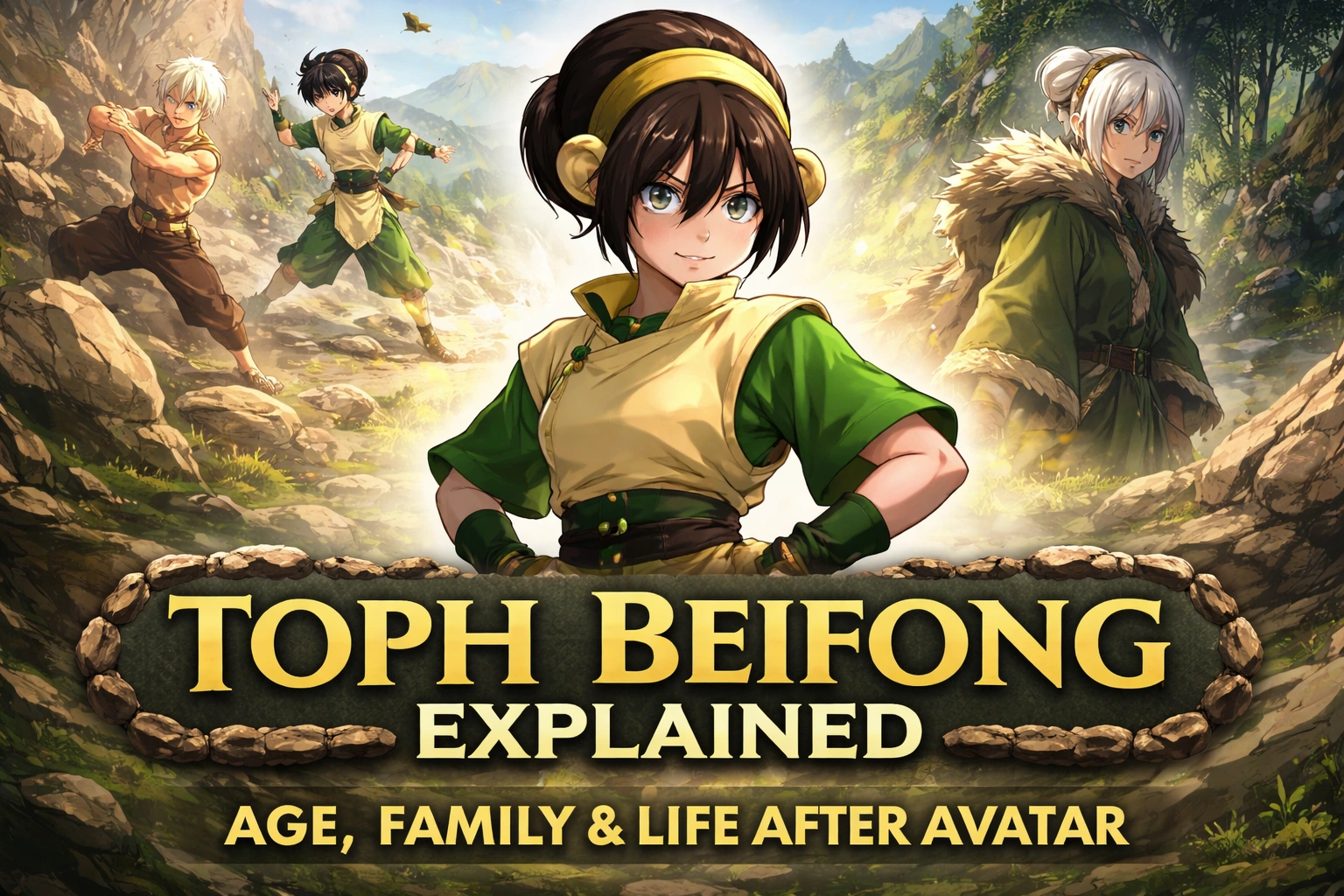
Why Toph’s Age and Role Are Often Misunderstood
Anyone who has followed Avatar: The Last Airbender closely knows that Toph Beifong doesn’t enter the story quietly. When she appears, she immediately feels different—more confident, more capable, and far less interested in approval than almost anyone else around her.
That presence is exactly why so many viewers misread her from the start.
According to our review of canon timelines, episode guides, and long-standing creator commentary, most confusion around Toph doesn’t come from a lack of information. It comes from how deliberately the show writes her against expectations. She speaks like an adult, fights like a veteran, and dismisses authority with ease—yet she is one of the youngest members of Team Avatar.
This disconnect is why basic questions about Toph’s age and role continue to surface years after the series first aired.
How Old Is Toph Beifong in Avatar?
Toph Beifong is twelve years old when she is introduced.
Canon places her at the same biological age as Aang, though the two characters feel nothing alike at first glance. While Aang’s youth is obvious in his humor and hesitation, Toph’s age is obscured by her independence and blunt confidence.
From a narrative standpoint, this contrast is intentional. Toph was raised in isolation, forced to develop self-reliance early, and trained by the original badgermoles rather than human teachers. Those experiences compress her emotional growth in a way that makes her feel older than she is.
This is also why “how old is Toph” remains such a common search query. The series never pauses to remind the audience that she is a child—because Toph herself would never allow it.
Why Viewers Often Assume Toph Is Older
Several factors consistently lead fans to overestimate Toph’s age:
- Her role as a teacher rather than a student
- Her complete lack of deference to adults
- Her physical confidence despite her blindness
- Her emotional independence from parental figures
When compared to Katara or even Sokka, Toph feels less reactive and more self-assured. But confidence is not the same as age, and Avatar makes a point of separating the two.
Interestingly, this mirrors a pattern seen with Aang as well—though in the opposite direction. Where Aang carries an ancient responsibility in a child’s body, Toph carries adult resolve in a child’s life stage. Internally linking these two perspectives helps readers understand how Avatar plays with age and maturity across its characters.
When Toph Appears and Why Her Entrance Changes Everything
Toph enters the story later than the rest of Team Avatar, and that timing matters.
By the time she appears, the audience has already adjusted to a certain rhythm: Aang learning, Katara guiding, Sokka strategizing. Toph disrupts that balance immediately. She doesn’t seek approval, doesn’t explain herself, and doesn’t soften her presence to fit the group.
According to long-time fan analysis, this late introduction is one of the reasons Toph feels larger than her screen time might suggest. She arrives fully formed, already confident in who she is, which again contributes to the illusion that she must be older.
But canon is clear: Toph is still a child navigating a world that constantly underestimates her—and sometimes overestimates her resilience.
Setting the Context for the Rest of Toph’s Story
Understanding Toph’s age and role at the beginning is essential before examining anything that comes later—her relationships, her children, or her life after the original series.
Avatar never treats Toph as a conventional character, and that applies just as much to her personal life as it does to her bending. The choices she makes later only make sense when viewed through the lens of who she was at twelve: fiercely independent, deeply private, and uninterested in following paths laid out by others.
That foundation shapes everything that follows.
Toph’s Relationships — What Canon Confirms and What It Intentionally Leaves Unsaid
If there’s one thing Avatar consistently does with Toph, it’s refuse to define her by who she’s attached to. That choice has frustrated some fans, fueled endless speculation for others, and—according to long-time followers of the franchise—feels completely in character.
Toph is written to resist labels. That applies just as much to her personal life as it does to her bending style.
Did Toph Ever Marry Anyone?
The short, canon-accurate answer is: the series never confirms that Toph married anyone.
Neither Avatar: The Last Airbender nor later canon material explicitly states that Toph had a spouse. This isn’t an oversight—it’s a deliberate absence.
According to interviews and long-standing creator commentary, some characters are given closed arcs, while others are allowed to remain unresolved. Toph falls firmly into the second category. Her story prioritizes independence over domestic closure.
That’s why questions like “who did Toph marry” keep resurfacing. The show leaves just enough space for curiosity, but never enough to confirm a traditional outcome.
Why Toph’s Love Life Is Left Ambiguous
From a narrative perspective, defining Toph through marriage would undercut one of her core traits: self-ownership.
Throughout the series, Toph rejects:
- Parental control
- Social expectations
- Authority figures who try to shape her
Romantic finality doesn’t fit easily into that framework.
Long-time fans often point out that Toph’s strength isn’t just physical—it’s emotional autonomy. She chooses when to connect and when to walk away, and the story respects that by not forcing her into a neatly packaged romantic resolution.
Does Toph Like Sokka? Clearing a Popular Fan Question
The Toph–Sokka question has lived in fandom spaces for years, largely because their dynamic feels different from standard Avatar pairings.
On screen, what we see is:
- Mutual respect
- Shared humor
- Occasional softness beneath sarcasm
What we don’t see is explicit romantic development.
Canon treats their interactions as situational rather than directional. Any deeper interpretation tends to come from fan projection rather than textual confirmation. According to episode analysis, their bond functions more as a momentary connection than a long-term trajectory.
This is why the question persists. The show invites interpretation—but never commits.
Why Fans Keep Searching for Definitive Answers
Toph’s relationships are a recurring search topic not because the show is unclear, but because it’s intentionally restrained.
Unlike characters whose emotional arcs are spelled out, Toph’s personal life exists mostly offscreen. That absence creates space for speculation, but it also reinforces her characterization: she is not someone whose worth or legacy depends on romantic definition.
Interestingly, this mirrors how the franchise treats certain other characters—especially those whose inner lives matter more than their outward milestones. Linking these themes across character analyses (such as your Aang article) helps readers see that this ambiguity is part of a larger storytelling philosophy, not a gap.
What Canon Silence Actually Tells Us
When Avatar doesn’t answer a question, it’s often answering it indirectly.
In Toph’s case, the lack of confirmed marriage or partner suggests something simple but powerful: her story is not meant to be completed through attachment. It stands on its own.
And that understanding becomes essential when we move into the next part of her life—one where she does become a parent, but still on her own terms.
Toph’s Children and Life After the Original Series
For a character whose personal life is mostly kept offscreen, Toph’s adulthood reveals something unexpected: she doesn’t settle into tradition, but she doesn’t disappear either. Instead, she evolves in a way that feels unmistakably Toph.
This is where many fans realize that her independence never faded—it simply changed shape.
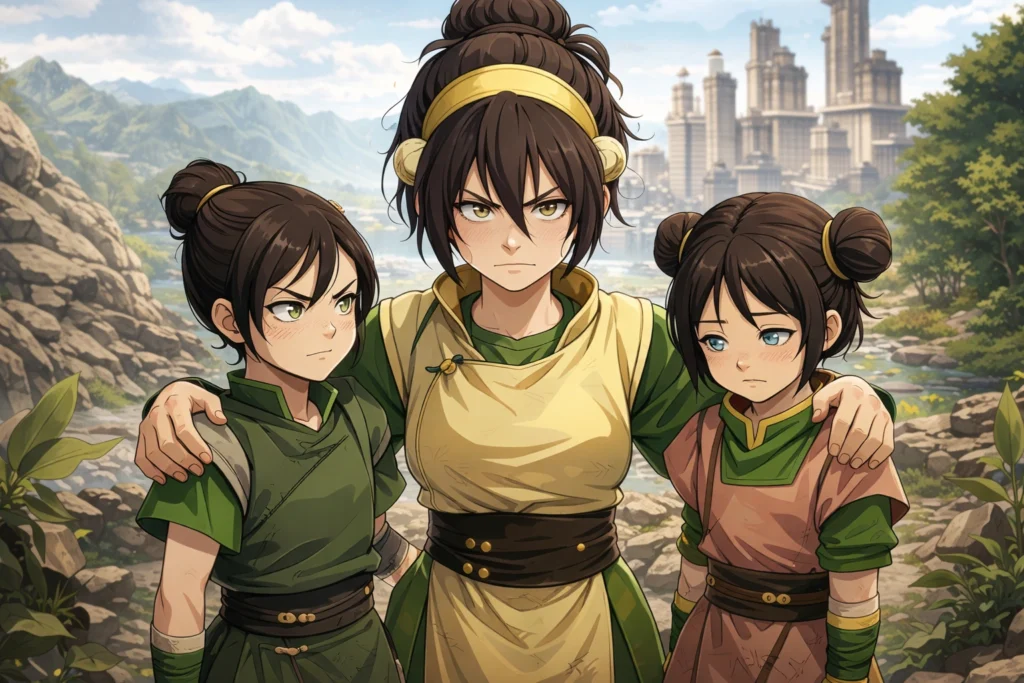
Who Did Toph Have Kids With?
Canon confirms that Toph Beifong has two daughters: Lin Beifong and Suyin Beifong.
What canon does not confirm—very intentionally—is who their fathers are.
Neither The Legend of Korra nor supplementary canon material names or even clearly hints at the identities of the men involved. This absence isn’t a retcon or an oversight. It’s a continuation of how Toph has always been written.
She doesn’t explain herself.
She doesn’t justify her choices.
And she certainly doesn’t offer neat answers for public consumption.
For long-time fans, this feels consistent rather than frustrating. Toph’s story has never been about transparency—it’s been about autonomy.
Why the Fathers Are Never Named
From a storytelling perspective, naming the fathers would shift attention away from the point.
Toph’s arc as a parent is not about partnership—it’s about responsibility, distance, and legacy. By keeping the fathers unnamed, the story centers her role alone, reinforcing the idea that Toph does not define family through convention.
According to creator discussions and years of fan interpretation, this choice also prevents speculation from overpowering character. The focus stays on how Toph raises her daughters, not on who stood beside her while doing it.
Toph as a Parent: Strength Without Softness
Toph’s parenting style surprises no one who understands her as a character.
She is:
- Emotionally distant
- Deeply protective
- Uninterested in micromanagement
Lin and Suyin grow up strong—but not unscarred. Their tension, resentment, and eventual understanding reflect the cost of being raised by someone who values independence above comfort.
What makes this compelling is that the narrative never paints Toph as wrong or right. It presents her choices as consequences of who she has always been.
She gives her children freedom.
She also gives them space—sometimes too much of it.
Why Toph Walks Away from Authority
At some point, Toph leaves formal leadership behind.
For fans paying attention, this isn’t a retreat—it’s a return to form.
Toph has never thrived inside systems. As a child, she rejected her parents’ control. As a teen, she rejected tradition. As an adult, she eventually rejects institutional authority as well.
Her decision to step away reflects a core truth: Toph was never meant to govern. She was meant to break ground, then move on.
Reframing Toph’s Adulthood
It’s tempting to judge Toph’s later life through a modern lens—expecting emotional availability, consistency, or reconciliation on demand.
Avatar doesn’t do that.
Instead, it asks the audience to accept that strength can coexist with flaw, and that growth doesn’t always look like softness. Toph remains uncompromising, even as the world around her evolves.
And in doing so, she stays one of the most honest characters in the franchise.
Toph’s Legacy — Strength, Solitude, and What Endures
By the time Toph reappears later in the Avatar timeline, she is no longer defined by competition or rebellion. Instead, she exists almost outside the world she helped reshape.
For longtime fans, this version of Toph doesn’t feel like a downgrade—it feels like a conclusion that makes sense.
Toph’s Impact Beyond Team Avatar
Toph’s most obvious legacy is metalbending, but that’s only the surface.
What she truly changes is the philosophy of earthbending. Before Toph, strength was associated with rigidity and rootedness. Through her, earthbending becomes adaptive, reactive, and deeply intuitive.
Entire institutions later build on techniques she developed as a child, even when her name isn’t spoken directly. That quiet influence reflects Toph’s character perfectly—she never needed recognition to validate her impact.
Toph in Later Avatar Eras
When Toph appears in The Legend of Korra, she is older, sharper, and completely uninterested in reclaiming relevance.
She lives away from cities, away from politics, and away from expectation.
To some viewers, this reads as withdrawal. To longtime fans, it reads as self-awareness. Toph understands that her role was to disrupt, not to maintain. The world moved forward using what she gave it, and she stepped aside without regret.
Her age doesn’t soften her. It clarifies her.
Why Toph Never Needed Closure
Unlike many characters, Toph’s story doesn’t aim for emotional symmetry.
She doesn’t reconcile every relationship.
She doesn’t resolve every tension.
She doesn’t explain herself one last time.
Avatar allows Toph to remain unresolved because resolution was never her goal. Her strength lies in motion, not arrival. In impact, not permanence.
This is why fans continue debating her choices long after the series ends. Toph refuses to be simplified.
Who Plays Toph in Live Action? What We Know So Far
Interest in live-action adaptations has reignited questions about how Toph will be portrayed.
As of now, officially confirmed casting information remains limited. What matters more than names, however, is whether the adaptation captures Toph’s essence: her defiance, her humor, and her refusal to be pitied.
For longtime followers, accuracy here isn’t about visuals—it’s about attitude.
Understanding Toph Beyond Strength Alone
It’s easy to reduce Toph to superlatives: strongest earthbender, inventor, prodigy.
But that framing misses what makes her endure.
Toph represents:
- Independence without apology
- Strength without performance
- Growth without conformity
She never becomes easier to understand—and that’s intentional.
Final Thoughts: Why Toph Beifong Still Resonates
Toph’s story works because it refuses to settle.
She begins as a contradiction and ends as one: powerful yet solitary, influential yet detached, uncompromising yet honest.
For those who’ve followed Avatar closely, Toph isn’t a character meant to be admired from a distance. She’s meant to challenge expectations—about strength, family, and fulfillment.
And that’s why, years later, people are still asking about her life. Not because the story failed to answer them—but because it trusted the audience to sit with complexity.
Frequently Asked Questions
How old is Toph Beifong in Avatar?
Toph Beifong is twelve years old when she is introduced in Avatar: The Last Airbender. Her confidence, independence, and role as Aang’s earthbending teacher often make viewers assume she is older, but canon places her at the same age as Aang.
When does Toph appear in Avatar: The Last Airbender?
Toph first appears in Book Two: Earth. She joins Team Avatar later than the other members, which contributes to the perception that she is more experienced or older than she actually is.
Did Toph ever get married?
Canon never confirms that Toph married anyone. Neither the original series nor later material explicitly states that she had a spouse, and this ambiguity aligns with how Avatar treats Toph’s independence and personal boundaries.
Who did Toph have kids with?
Toph has two daughters, Lin Beifong and Suyin Beifong. However, canon deliberately does not reveal who their fathers are. This absence is intentional and keeps the focus on Toph as a parent rather than on romantic backstory.
Does Toph like Sokka?
The series shows moments of mutual respect and playful interaction between Toph and Sokka, but it never confirms a romantic relationship. Any deeper interpretation comes from fan speculation rather than canon text.